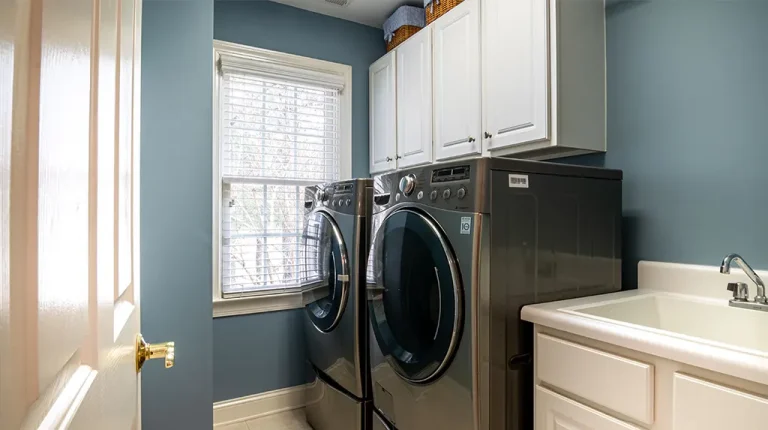

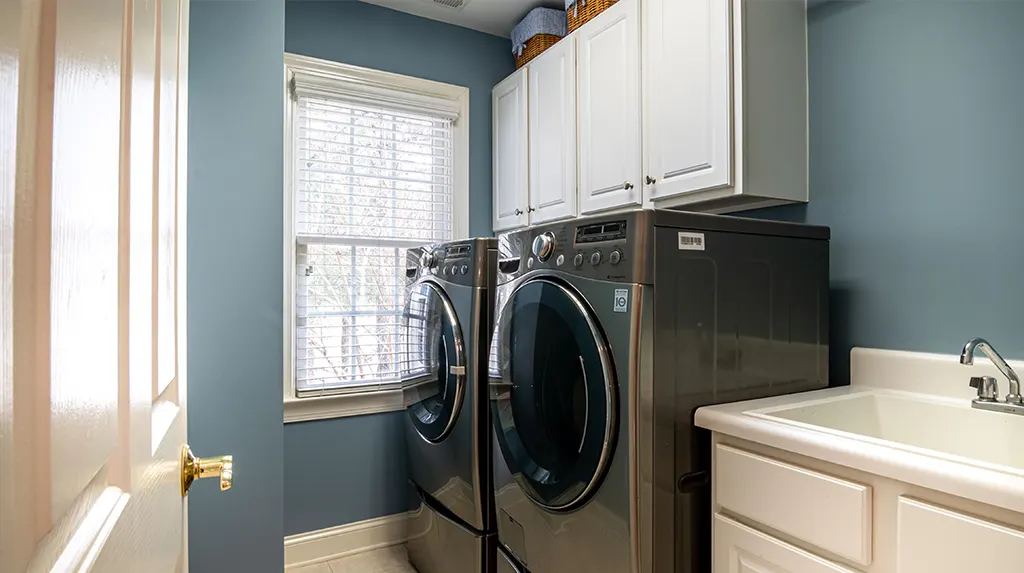
The utility room does more work than any other room of its size, and in Ireland it does more again. Coats come in wet for most of the year. Boots come in muddy. Washing that would dry outside in a drier climate spends months on an airer indoors.
Most utility rooms are planned as a place to put the washing machine. That’s the smallest part of what the room actually has to do.
The Room Has Three Jobs That Conflict
A utility room is usually asked to handle three things at once:
- Wet storage: coats, boots, umbrellas, dog towels
- Laundry: machines, sorting, drying, folding
- Overflow: cleaning equipment, bulk food, bins and recycling
The conflict is obvious once it’s written down. Wet, dirty items and clean, dry items are sharing a small room. If the layout doesn’t separate them deliberately, the clean things end up damp and everything smells faintly of wet coat by February.
Separating those zones is the single most useful decision in a utility room design.
Wet Things Need Air, Not Doors
The instinct is to hide wet gear behind a cupboard door. It’s the wrong instinct. A wet coat in a sealed cupboard has nowhere to dry, and the result is the same mould and musty smell that appears behind a wardrobe on a cold wall.
Wet storage should be ventilated:
- Open hanging rails or hooks rather than a closed cupboard, or vented doors if it has to be enclosed
- Hooks at two heights so children can hang their own coats instead of dropping them
- An open shelf or boot tray at floor level on a surface that tolerates water
- A clear drip zone just inside the external door, with a wipeable floor under it
Give wet items somewhere obvious to go and they stop migrating into the hall.
Drying Laundry Indoors Is the Real Problem
For much of the Irish year, washing dries indoors. A single load releases litres of water into the air, and that moisture has to go somewhere. If the utility room can’t get rid of it, it moves through the house and condenses on the coldest surfaces it can find.
Three things make the difference:
- Mechanical extraction. A humidity-controlled extractor fan that runs when moisture rises is the most important fitting in the room. It matters more than any cupboard in it.
- The right dryer. A vented dryer needs an external duct. A condenser or heat pump dryer doesn’t, but still adds warmth and some moisture to the room, so extraction is still needed.
- Dedicated drying space. A ceiling-mounted pulley airer keeps drying off the floor and out of the way. A purpose-built drying cupboard with extraction works even better where there’s room for one.
The alternative is washing drying in bedrooms, which is how most household damp problems start.
Plan the Flow From Dirty to Clean
A utility room works best when it has a direction. Dirty comes in at one end, clean leaves at the other.
Starting at the external door: drip zone, boots off, coats hung, laundry sorted, machines, then worktop for folding, then storage for clean linen. Clean folded laundry should never be stored next to the wet coats, which is exactly what happens when the room is planned around where the plumbing already is.
Practical Dimensions
A few working figures make planning easier:
- Standard worktop height of 900mm over the machines gives a surface for sorting and folding
- Allow roughly 600mm width and 600mm depth per appliance, plus a little clearance for hoses and ventilation
- A full-height cupboard at 300mm to 400mm deep takes a vacuum, mop, brush and ironing board
- Two bins for general waste and recycling need a planned home, ideally a pull-out unit rather than floor space
A deep sink earns its place if there’s room for one. Muddy boots, paint brushes and dog bowls all have to be washed somewhere, and it may as well not be the kitchen sink.
Finishes That Survive the Room
This is a wet room in all but name, and the specification should reflect that.
Moisture-resistant board with properly bonded edges is worth paying for, particularly at floor level where water actually lands. Exposed or poorly banded chipboard near a boot tray will swell within a couple of winters. A hard-wearing worktop, a wipeable floor, and a plinth that tolerates a mop are all small details that decide whether the room still looks right in five years.
A utility room planned around Irish conditions rather than around the washing machine takes pressure off every other room in the house. It keeps the wet out of the hall, the damp out of the bedrooms, and the clutter out of the kitchen.
If you’re ready to transform your space, let’s get started.