
Most fitted furniture still relies heavily on shelves. They’re cheaper to build, quicker to install, and they’re what people expect to see inside a cupboard. But for the way most storage actually gets used, a deep drawer does the same job better in most situations. Once people live with proper drawers, they rarely want to go back to shelves.
The reason comes down to one simple thing. A shelf keeps its contents still and makes you go to them. A drawer brings its contents to you.
The Problem With Shelves
A shelf only gives you easy access to the front. Anything behind the first row gets harder to reach and harder to see. Over time, the back of a shelf becomes storage you forget you have. Items sit there untouched because reaching them means moving everything in front first.
Lower shelves make this worse. To see what’s on a shelf below waist height, you have to bend down and peer into a dark space. The lower and deeper the shelf, the more awkward it becomes. In a base kitchen cabinet, the bottom shelf is often the least used space in the whole kitchen for exactly this reason.
Shelves also waste vertical space. You set the shelf height for the tallest item you want to store, and everything shorter leaves a gap of dead air above it. That space can’t easily be used for anything else.
Why Drawers Work Better
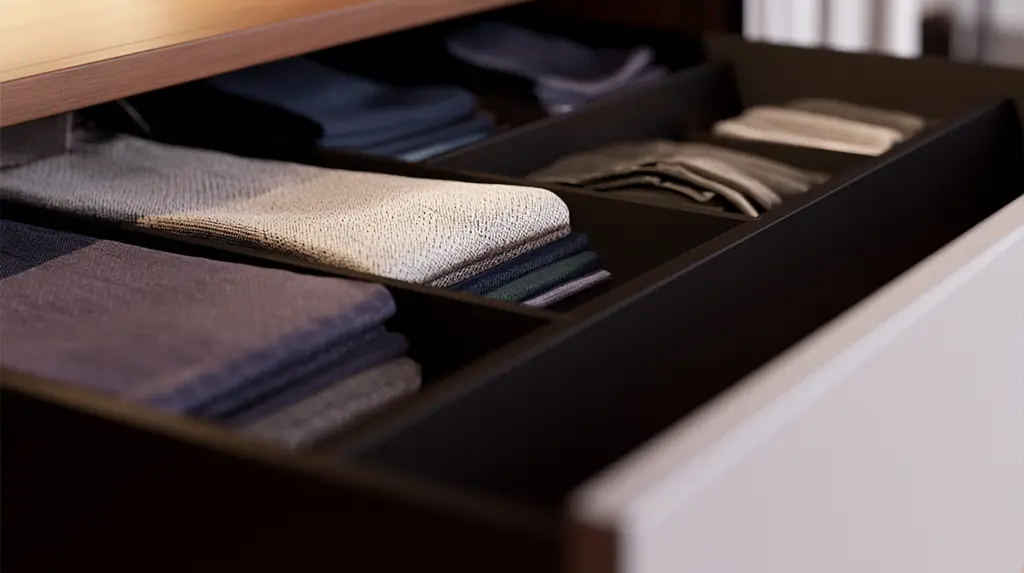
A deep drawer solves all of this at once. When you open it, the entire contents slide out towards you on runners. Nothing stays hidden at the back. You look down into the drawer and see everything in one glance.
This changes how the space gets used day to day:
- Everything is visible. No moving front items to find what’s behind them. You see the whole contents from above.
- Everything is reachable. No bending into a dark cupboard. The drawer comes to you at a comfortable height.
- Nothing gets lost. The back of the drawer is just as accessible as the front, so all of the space gets used.
- Organisation holds. Items stay where you put them. A drawer keeps its layout in a way an open shelf never does.
Modern full-extension runners are what make this work. They allow the drawer to pull out completely, so even the very back is in easy reach. Older or cheaper runners that only pull out partway lose much of this benefit, which is why the quality of the hardware matters as much as the drawer itself.
Drawers Hold More Than People Expect
The most common objection to drawers is that they can’t take the weight of heavier items. This used to be true. It no longer is.
Good quality drawer runners are rated to carry significant loads, easily enough for a drawer full of pots, pans, crockery, or tinned goods. A deep pan drawer under a hob will comfortably hold a full set of heavy cookware and open smoothly every time. The weight limit is rarely the problem people imagine it to be, provided the runners are specified properly.
This is why deep drawers now work in places that were once shelf-only territory. Pots and pans, plates and bowls, food storage, even small appliances all sit better in a deep drawer than on a shelf where they’d be stacked and buried.
The Space a Drawer Needs
There’s one real drawback to drawers, and it’s about space. A drawer has to open into the room. A full-extension deep drawer projects out by roughly its own depth, so you need clear floor space in front of it to use it fully.
In a kitchen or bedroom with normal circulation space, this is rarely a problem. It matters most in tight rooms and narrow layouts. In a small room, or a walk-in wardrobe with a narrow aisle, a deep drawer that pulls right out can need more clear space than the layout comfortably allows. Two runs of drawers facing each other across a narrow gap can’t both be fully open at once.
A shelf behind a hinged door needs the door to swing open, but once it’s open, you reach straight in without pulling anything further into the room. In a genuinely tight space, that can be the deciding factor in favour of shelves.
Where Shelves Still Make Sense
Drawers aren’t the answer to everything, and it’s worth being honest about where a shelf is still the better choice.
- Tall items. Bottles, small appliances, and anything with real height are often better on an open shelf or in a tall cupboard than lying down in a drawer.
- Hanging space. In a wardrobe, hanging rails do a job no drawer can. Drawers work best alongside hanging, not instead of it.
- Display. Anything you want on show, from books to glassware, belongs on an open shelf rather than hidden in a drawer.
- Light, rarely used items. For things reached for only occasionally, a high shelf is a sensible place to keep them out of the way.
The best storage usually combines both. Drawers for the everyday items that benefit from full access, shelves and hanging for the things that genuinely suit them.
Is It Worth the Extra Cost?
Drawers cost more than shelves. There’s more hardware, more construction, and better runners, which add to the price. A cabinet fitted with deep drawers will always cost more than the same cabinet with fixed shelves.
For most people, it’s worth it, because a kitchen or wardrobe is used every day for years and better access is felt constantly over that time. The sensible approach is to put drawers where they earn their keep, in the zones used most, and use shelves where they genuinely fit better.
Deep drawers aren’t a trend or an upgrade for the sake of it. They’re simply a better way to store most things, and once a space is planned around them properly, the difference in everyday use is hard to ignore.
If you’re ready to transform your space, let’s get started.