
A walk-in wardrobe sounds straightforward until you start measuring. The room might exist – a spare bedroom, a boxroom, a section of a large master – but whether it can function as a proper walk-in is a different question. The difference between a walk-in wardrobe and a very inconvenient storage room comes down to a few critical dimensions.
The Number Most People Get Wrong
The minimum usable width for a walk-in wardrobe is 1800mm. That’s 600mm for hanging on one side, 600mm for hanging on the other, and 600mm of clear aisle space between them. Go narrower than that, and the aisle becomes too tight to use comfortably. You’re turning sideways to get dressed, doors are brushing clothing, and the whole point of a walk-in is defeated.
A 600mm aisle is the absolute minimum. 700mm is comfortable. 800mm or more gives you room to crouch at drawers, open storage boxes, and move freely without feeling cramped.
If the space is only wide enough for hanging on one side, it’s a dressing room, not a walk-in. That’s still a useful layout, but it needs to be planned differently.
Minimum Dimensions by Layout Type
Single-sided layout (hanging on one wall only):
- Minimum width: 1400mm (800mm hanging depth plus 600mm aisle)
- Practical minimum length: 1800mm
- Works well in narrow spaces like converted boxrooms or wide corridors
Double-sided layout (hanging on both walls):
- Minimum width: 1800mm
- Practical minimum length: 2200mm
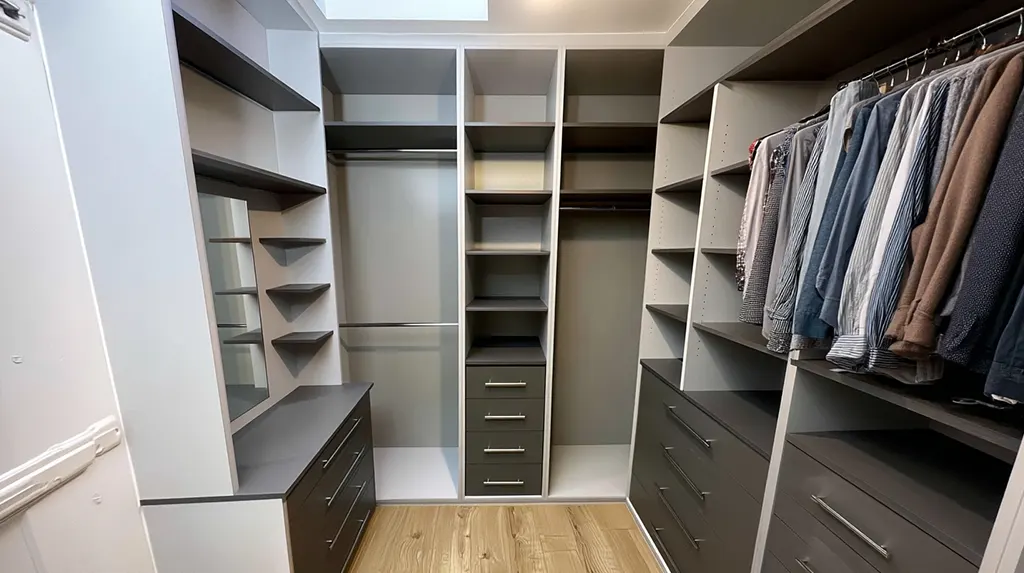
- The standard walk-in configuration
U-shaped layout (hanging on three walls):
- Minimum width: 2200mm
- Minimum length: 2400mm
- Requires a well-placed door — ideally centred on the fourth wall
- Best use of square or near-square rooms
Island layout (hanging on walls plus central island unit):
- Minimum width: 3000mm
- Minimum length: 3000mm
- The island needs 900mm clearance on each accessible side
Hanging Depths and Heights
Standard hanging depth is 560mm to 600mm. Going shallower than 560mm means clothes on hangers protrude past the rail and catch on doors or the person walking past. Going deeper than 600mm wastes space and makes items at the back harder to see.
Hanging heights depend on what’s being stored:
- Full-length garments (dresses, suits, coats): minimum 1700mm clearance from rail to floor
- Short hanging (shirts, jackets, folded trousers): 1000mm clearance, allowing a second rail or drawer unit below
- Double hanging (two rails stacked): each section needs 1000mm, total height from floor to top rail around 1950mm to 2000mm
Ceiling height matters here. A standard 2400mm ceiling gives enough room for double hanging with a shelf above. Lower ceilings restrict the layout. Higher ceilings — anything above 2600mm — are worth using with tall shelving or a top rail for seasonal storage.
What Eats Into Your Space
Several factors reduce the usable dimensions of a walk-in before a single unit goes in:
- Door swing: A hinged door opening inward takes 700mm to 800mm of aisle space when open. Either recess the door, use a sliding door, or plan the aisle to account for it.
- Light switches and sockets: These need to be positioned before units go in. A socket placed where a unit will sit becomes inaccessible. Lighting circuits need to be run before installation.
- Sloped ceilings: In attic conversions or rooms under a roof pitch, the usable hanging height drops significantly toward the eaves. Full-length hanging may only be possible in the centre of the room.
- Radiators: A radiator on a wall earmarked for hanging reduces that wall’s usable length and creates a heat zone that isn’t ideal for clothing storage long term.
The Honest Minimum
If the space is smaller than 1800mm wide and 2000mm long, a traditional walk-in wardrobe won’t work well. The aisle will feel like a corridor, and the storage will be awkward to use daily.
That doesn’t mean the space is wasted. A well-planned single-sided dressing room in 1400mm x 2000mm can hold a significant amount of clothing with proper internal organisation — full-length hanging, short hanging with drawers below, shelving for folded items and shoes. It won’t feel like a walk-in, but it will function better than a badly proportioned one.
The best walk-in wardrobes are the ones planned around how the space is actually used, not just how much can be fitted in. Getting the aisle width right, the hanging heights correct, and the door position sorted before anything is built makes the difference between storage that works every morning and storage that just about fits.
If you’re ready to transform your space, let’s get started.