
When Ray Kroc was perfecting the first McDonald’s kitchen, he didn’t start with blueprints. He taped out the entire layout on a parking lot, had staff walk through every movement, and adjusted the spacing until the workflow was right. Only then did he build. The principle was simple: test the reality before you fix it in place.
Most home kitchens skip that step entirely. Cabinets are ordered to standard dimensions, fitted to the available walls, and handed over. The problems only show up in daily use — the corner that’s impossible to reach, the deep shelf where things disappear, the cabinet that looks full but holds half of what it should. Dead space in kitchen furniture is one of the most common complaints from homeowners, and it’s almost always a planning problem rather than a size problem.
The General Problem
Most standard kitchen layouts are built around fixed cabinet sizes. Manufacturers produce units in set widths and depths, and kitchens are designed to accommodate those dimensions rather than the other way around. The result is storage that fits the room on paper but leaves pockets of unusable space in the corners, at the ends of runs, and behind doors that can’t open fully.
A kitchen that looks well planned from the outside can still hide a significant amount of wasted space inside. The problem is rarely visible until the kitchen is in daily use, by which point it’s difficult and expensive to correct.
Custom fitted furniture avoids this by designing around the actual dimensions of the room. Every cabinet, every shelf, and every drawer is built to match the space rather than approximate it.
Corner Units
The corner is where most kitchen dead space lives. Two runs of cabinets meet, and the internal pocket created by that junction is deep, dark, and awkward to reach. In a standard installation, this area is often fitted with a large single door that opens onto a space most people can only access on their hands and knees.
There are several approaches that make corner space genuinely usable:
- Lazy Susans and carousel systems rotate on a central axis, bringing items at the back of the corner forward with a single turn. They work well for pots, pans, and dry goods.
- Le Mans pull-out systems use two kidney-shaped shelves on a hinged arm that swing out when the door opens, giving full access to both sides of the corner.
- Drawers built into the corner angle work in some layouts where the corner is wide enough to accommodate a diagonal front panel. These are less common but very effective when the geometry allows it.
- Open corner shelving removes the door entirely and uses the corner as display or everyday access storage. It works best when the items stored there are used frequently.
The right solution depends on the corner dimensions, the cabinet height, and what will be stored there. None of these options can be retrofitted easily into a standard corner unit. They have to be specified before the kitchen is built.
Base Cabinet Depth
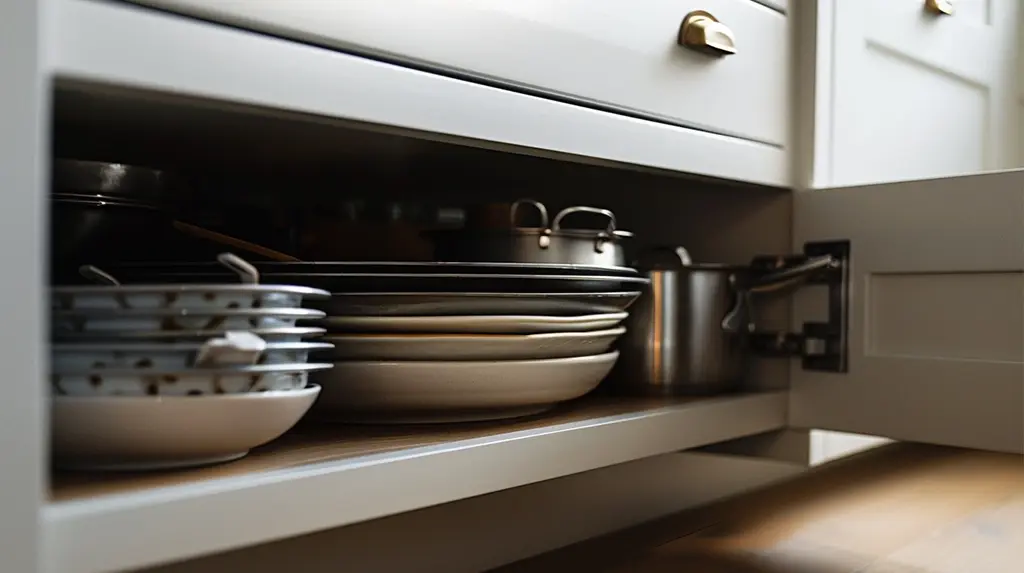
Standard base cabinets are typically around 600mm deep. That depth made sense when kitchens were designed around standing at a worktop with limited reach. In practice, it creates a problem: the back third of most base cabinets is rarely used.
Items get pushed to the back and forgotten. Pots stack in front of other pots. The cabinet looks full but is only half functional. The deeper the cabinet, the worse this becomes.
Several solutions address this directly:
- Full-extension drawer systems pull the entire contents of a cabinet forward, making everything visible and reachable. A single deep drawer replaces a shelf and door, and nothing stays hidden at the back.
- Pull-out internal shelves work on the same principle inside an existing door-fronted cabinet. The shelf slides forward on runners, bringing the back of the cabinet into reach.
- Tiered inserts and organisers divide the depth into zones, so items at the back are stacked at a different height to items at the front. It doesn’t solve the reach problem, but it makes the space easier to manage.
- Reduced-depth cabinets in specific zones — beside appliances or under windows — can eliminate the problem entirely in areas where full depth isn’t needed.
Depth is worth considering carefully at the planning stage. More depth doesn’t always mean more storage. In many kitchens, shallower cabinets with better internal organisation outperform deeper ones that are difficult to use.
Getting It Right From the Start
Dead space in a kitchen is almost always easier to prevent than to fix. Once cabinets are in, the options for improving them are limited. Pull-out systems can be added later, but they often don’t fit standard carcasses cleanly. Corner solutions require the right internal dimensions from the start.
The most effective approach is to plan the storage around how the kitchen will actually be used. That means thinking about what gets stored where, how often it’s accessed, and what kind of retrieval makes sense for each zone. A fitted kitchen designed around those questions will use its space more efficiently than one built to standard dimensions and adjusted later.
If you’re ready to transform your space, let’s get started.