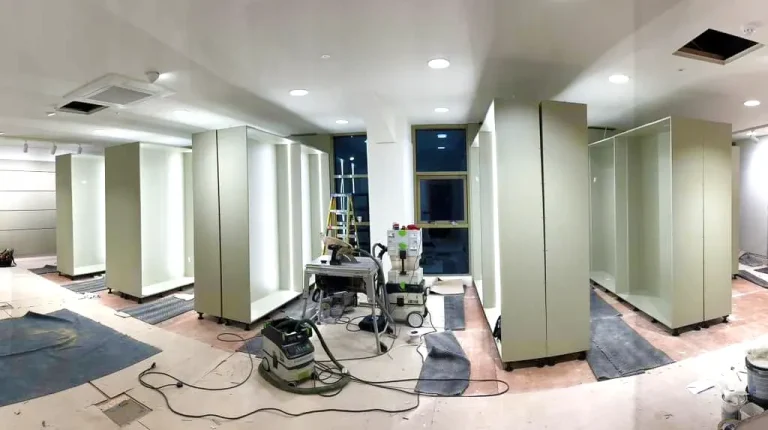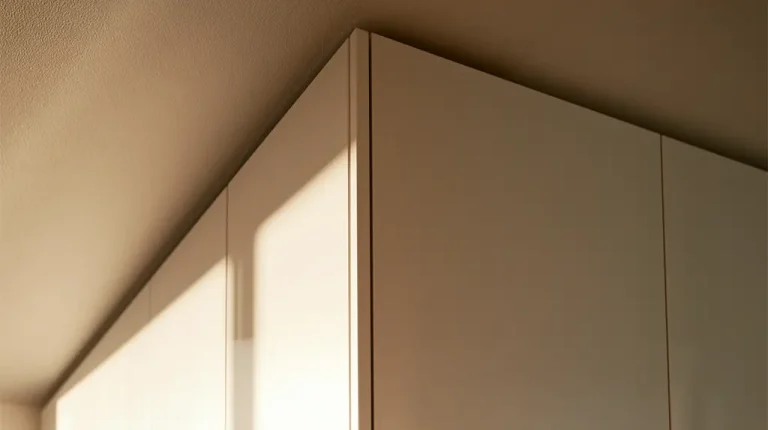

Corner wardrobes look straightforward on paper. Two walls meet at a right angle, there’s floor space to work with, and storage is needed. The problem is that corners are rarely as simple as they appear, and the complications tend to show up after installation rather than before.
The Geometry Problem
Most walls in Irish homes are not perfectly square. The angle between two walls is rarely an exact ninety degrees, and floors are rarely level across the full span. On a straight-wall wardrobe, small irregularities can be managed with scribing or trim. In a corner, they compound.
A corner wardrobe runs along two walls simultaneously. If the angle between them is slightly off, the carcasses won’t align cleanly at the join. Panels leave visible gaps. Doors don’t close evenly. The whole unit can look misaligned even when each individual section is built correctly.
Accurate measurement in a corner means checking the angle, the depth on both sides, and the floor level across the full run. A laser level handles this properly. A tape measure alone doesn’t give you enough information.
The Dead Space Inside
When two sections of a wardrobe meet in a corner, they create an internal pocket that’s difficult to use. Hanging rails on either side can’t extend into it. Drawers stop short of it. Shelves that run into the corner are awkward to reach.
There are ways to address this, but each one has to be built into the design from the start:
- Rotating corner systems give full access to deep corner space and work well in larger wardrobes
- Pull-out carousels bring items forward so nothing gets lost at the back
- Fixed shelf zones are the simplest option, best suited to folded items or storage that doesn’t need frequent access
The internal dimensions need to allow for whichever solution is chosen before a single panel goes up. Retrofitting a corner access solution into a wardrobe that wasn’t designed for one is rarely clean or cost-effective.
Door and Sliding Panel Complications
Corner wardrobes often use a mix of hinged and sliding doors, or a sliding system that wraps around the corner. Both create specific planning requirements.
With hinged doors, the swing arc on each section needs to be checked carefully. A door on one side can block access to the section beside it if the clearance hasn’t been accounted for. It’s easy to miss a drawing and it’s immediately obvious in use.
With sliding doors, the track system has to turn the corner and the panel overlap needs to work across both sections. The weight of larger panels puts more demand on rollers and track alignment. If either wall carries the load unevenly, the doors will begin to drag or drift. Cheap hardware tends to show this quickly in a corner layout.
Lighting
The corner creates a shadow zone that straight-wall wardrobes don’t have. Even with ceiling lights in the room, the interior of a corner wardrobe tends to be darker at the centre because the walls on both sides block ambient light.
Internal LED lighting solves this, but only when it’s planned before installation. Cables need a route, and that route is easiest to build in when the carcasses are going up. Adding lighting after the fact usually means exposed conduit or cutting into panels. It’s not complicated to get right, but it has to be part of the original layout.
Why the Planning Stage Matters More Here
A well-designed corner wardrobe offers more usable storage than most straight-wall alternatives within the same footprint. Both walls are used, and the corner becomes part of the system rather than wasted space.
Getting there depends on decisions made before anything is built. The geometry has to be measured properly. The internal layout has to account for access. Doors need clearance. Lighting needs a position. None of these is a difficult problem, but they don’t fix themselves once the wardrobe is in.
If you’re ready to transform your space, let’s get started.