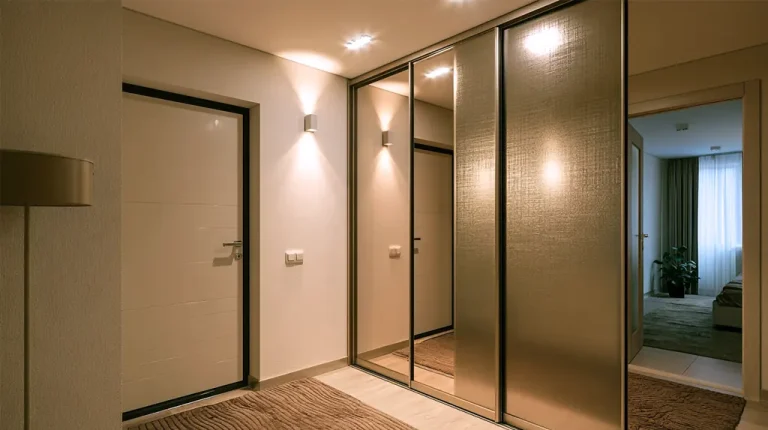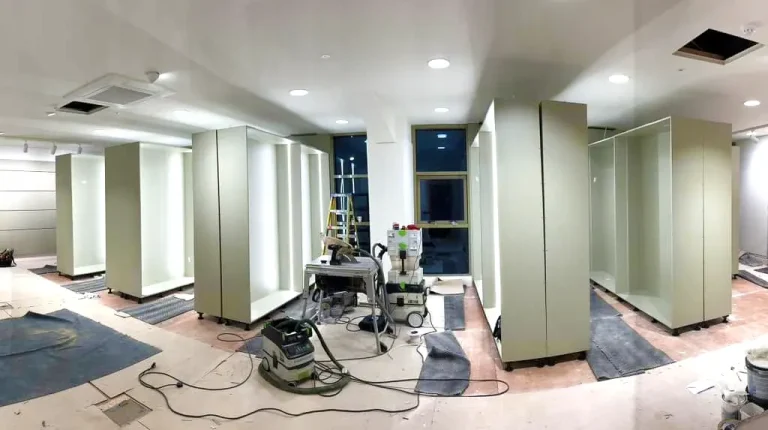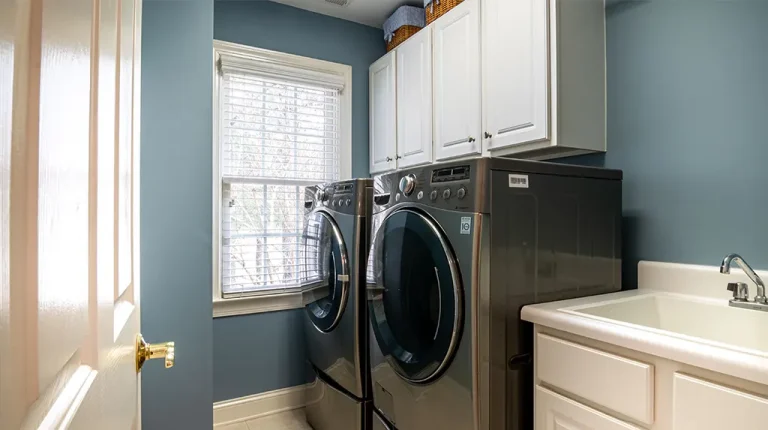

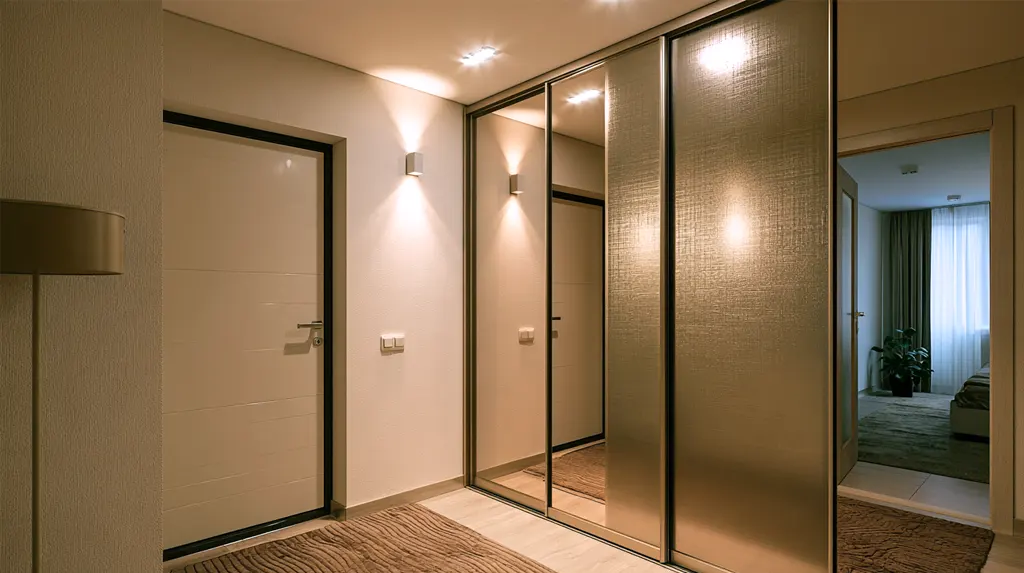
They’re both called wardrobes; they both hold clothes, and they’re often specified the same way. A run of hanging space, a shelf above, maybe a drawer at the bottom.
In practice, they’re doing completely different jobs. One stores clothing for one or two people in a quiet room. The other handles wet coats, dirty boots, and five people leaving the house at the same time. Designing them identically means one of them works badly.
They Hold Different Things
A bedroom wardrobe is dominated by hanging. Long garments need around 1700mm of clear height, shorter items around 1000mm, and the rest of the space is divided between folded storage and shoes that are already clean and dry.
A hall wardrobe holds almost nothing that needs full-length hanging. Coats and jackets are short, so 1000mm to 1100mm of hanging height is usually plenty. That single difference frees up a large amount of space lower down, which is exactly where a hall needs it.
What actually goes in a hall unit is a different list:
- Coats and jackets, often bulky and sometimes wet
- Shoes and boots, frequently dirty
- School bags, work bags and sports kit
- Umbrellas, hats, gloves, dog leads
Planned around that list, a hall wardrobe ends up with less hanging, more open shelving at floor level, and a lot more hook space than a bedroom unit would ever need.
The Hall Deals With Wet and Dirty
This is the biggest practical difference, and it’s the one most often ignored. A bedroom wardrobe stores dry items. A hall wardrobe takes in whatever the weather delivered.
That changes the specification:
- Ventilation matters. A wet coat in a sealed cupboard has nowhere to dry, and the result is a musty smell within weeks. Vented doors, an open section, or simply leaving the coat zone uncovered all solve it.
- Floor level needs to tolerate water. An open shoe shelf on a wipeable surface works far better than an enclosed base that traps moisture.
- Materials have to cope. Moisture-resistant board and properly bonded edges near the floor are worth paying for. Exposed chipboard edges beside a pile of wet boots will swell within a couple of winters.
A bedroom wardrobe on an internal wall faces none of this. A hall unit beside an external door faces it every day from October onwards.
Traffic and Speed Change the Design
A bedroom wardrobe gets opened calmly, maybe twice a day, by one person. A hall wardrobe gets used in a hurry, by everyone, ten or twenty times a day.
Two things follow from that.
Hooks beat hangers. Nobody puts a coat on a hanger on the way out the door. They hang it on a hook, or they drop it on the stairs. A hall unit with generous hook space gets used properly, and hooks at two heights means children can hang their own things instead of leaving them on the floor.
Hardware takes more abuse. Doors get pushed shut with an elbow and drawers get closed with a knee. In a hall, hardware quality shows up far sooner than it does in a bedroom.
Space Works Differently Too
Bedrooms usually allow a standard 600mm depth, which is what a conventional hanging rail needs. Halls often can’t give that.
If the available depth is only 350mm or 400mm, a standard front-to-back rail won’t work, and trying to force one in produces a unit where the doors never close properly on a full coat. The honest answer in a shallow hall is to use hooks, a side-hung rail, or a pull-out rail designed for the depth rather than pretending the space is deeper than it is.
Halls also benefit more from running full height to the ceiling. The footprint is tight, so the only direction left is up, and the top section is a sensible home for things used seasonally.
What They Do Share
Both work better with drawers positioned within comfortable reach rather than at floor level. Both benefit from internal lighting, since both tend to sit in darker parts of the house. And both depend on the same thing: deciding what actually goes inside before the layout is drawn.
The problem is often not the quality of the wardrobe itself, but it’s that a design intended for a bedroom ends up in a hall, where it was never going to work.
If you’re ready to transform your space, let’s get started.